Food & decor
Jasmine, gold and banana leaf
By Chaithanya Ganesha · 17 August 2026 · 5 min read
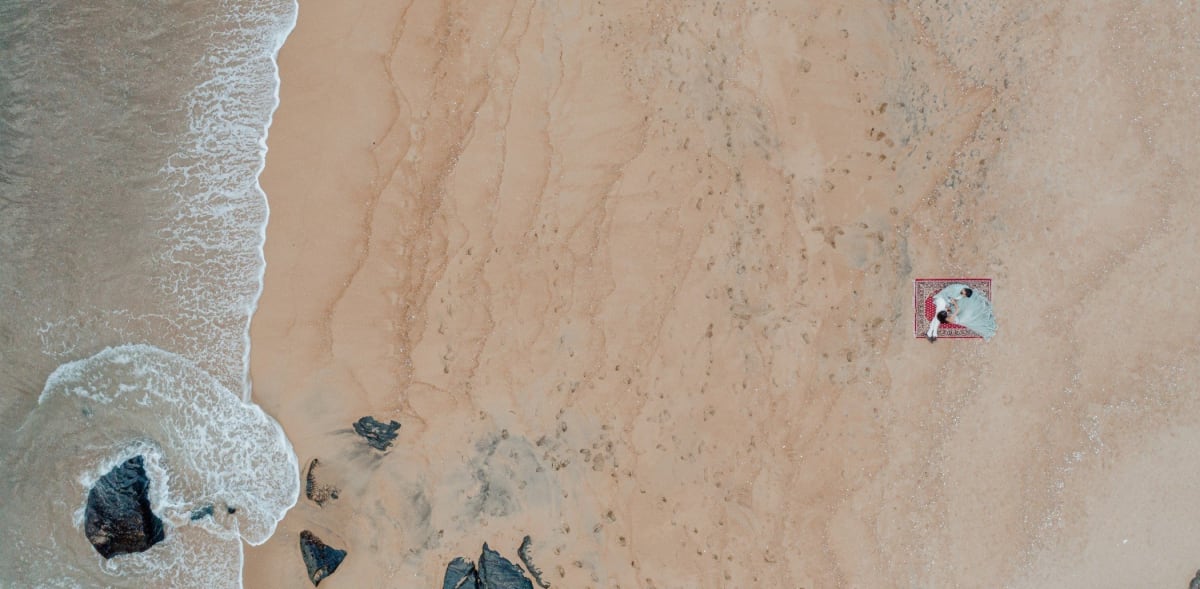
What does traditional Kerala wedding decor look like?
Kerala wedding decor is built from a small, disciplined material palette: the cream-and-gold of kasavu cloth, strings of white jasmine, green banana leaf and plantain, brass lamps and their flames. The restraint is the style — white ground, one thread of gold and colour running through it — and it photographs better than abundance. Design-led weddings work inside this language, drawing and building structures for the specific venue rather than assembling rented pieces.
Most Indian wedding decor starts from a mood board. Kerala’s starts from a wardrobe: the kasavu — cream cloth with its woven gold border — that the state has dressed its celebrations in for generations. White ground, one line of gold running through it. Once you see that, you see the whole aesthetic, and you understand why Kerala weddings photograph the way they do. The palette was settled long before any of us arrived with a design degree.
A small vocabulary, used precisely
The materials of a Kerala wedding fit in one sentence: jasmine, gold, banana leaf, brass, flame. That brevity is not poverty — it is discipline, and it is the entire secret.
- Jasmine is the scent and the texture: white strings worn in the hair and hung by the metre, a flower that reads as garlands and canopies rather than as bouquets.
- Gold is the thread, never the ground. It lives in the kasavu border, the lamp, the jewellery — a line of light through white, not a wall of it.
- Banana leaf and plantain bring the green: whole plantain stems flanking an entrance, the leaf under the sadya, a green that no dyed material matches.
- Brass and flame carry the ceremony: the tall oil lamp whose lighting opens the event, and the warm point of fire that gives every photograph its centre.
Put differently: the state’s decor language already obeys the rule good designers spend careers learning — a light ground, one signature thread of colour, and restraint everywhere else. Readers who notice that this describes our own site’s design are noticing correctly. We stole it from the kasavu too.
What a design team adds
If the language is settled, what is left to design? Everything, it turns out — because speaking a language and having something to say in it are different skills. This is where we should declare our interest plainly: design is the reason our studio exists. The parent company was founded by an architect, design is done in-house, and a six-person design team works on each wedding alongside the two founders. The structures — the mandapam frame, the entrance, the pavilion on the waterline — are drawn and built for the specific event and the specific venue rather than pulled from a rental catalogue. The about page carries the full account.
What that means in practice, at a Kerala wedding:
- The venue leads. A hall stage, a lakefront pavilion and a heritage courtyard are three different design problems, and a structure drawn for one looks borrowed at the others. Designing to the venue is most of the work.
- The budget concentrates. Decor money goes where every camera faces — the stage and the entrance — because a defined focal point beats thin coverage of a large space every single time.
- The materials stay honest. Real jasmine, real leaf, real brass. The traditional palette is cheap to imitate and unmistakable when it is imitated; the flowers are the first thing a Kerala grandmother inspects at close range.
Restraint travels well
The unexpected virtue of the Kerala palette is how gracefully it extends. Because the ground is white and the accents are few, the language absorbs a family’s additions — a community’s ritual objects, a colour the couple loves, the specific flowers a season offers — without collapsing into noise. The white-and-gold frame makes almost anything placed inside it look intentional. Compare that with a maximal theme, which each addition pushes closer to clutter, and you see why the old palette keeps outliving its replacements.
The meal completes the picture, of course — the sadya’s banana leaf is the decor language served as lunch, and how that service actually runs is its own story. Between the two, leaf and lamp, Kerala solved wedding aesthetics before wedding designers existed. The job now is to build each wedding’s own sentence in a language the state already made beautiful.
Keep reading
The guides behind this post
Venues mentioned
More from the journal
Questions we hear on this
Does traditional Kerala decor limit what a couple can choose?
The opposite, in practice. The white-and-gold ground is a frame, not a rulebook — it absorbs a couple’s colour, a community’s ritual pieces or a season’s flowers gracefully, because a restrained ground makes additions look deliberate. The weddings that feel cluttered are usually the ones that abandoned the ground, not the ones that decorated it.
What does an in-house design team change about wedding decor?
The structures are drawn for your venue and your event rather than assembled from rented inventory, which is the difference between a stage that fits a lakefront pavilion and one that merely arrived at it. In our studio a six-person design team works on each wedding alongside the two founders, with the parent company founded by an architect.
Where should a limited decor budget go at a Kerala wedding?
To the stage and the entrance — the two points every photograph faces. Concentrated there, a modest budget defines the whole event; spread across a large hall, the same money disappears. It is the most controllable major line in the budget, and concentration is how it earns its keep.
Tell us about the wedding
Dates, guest numbers, where the family is from. Enough to reply with something useful rather than a brochure.